

Mohnish Pabrai is famous for spending over $650,000 just to have an opportunity to have a talk over lunch with the chairman and CEO of Berkshire Hathaway, Warren Buffett.
Pabrai diligently follows value investing and has shown no interest in companies that are undervalued by about 10%. The Indian-American investor is aiming to shoot up his investments five times in few years. If the opportunity that comes along the way won’t make him achieve it, he surely would pass.
Subsequent to selling his IT business for about $6 million back in 2020, he launched Pabrai Investment Funds, which is modeled and geared after Buffett’s investment partnerships.
Pabrai goes with the approach of “heads I win, tails I don’t lose much” in investing, and with his success now, we can safely say that his strategy is working. The portfolio he holds home in on India and springing up nations because he can’t find undervalued, or mispriced stocks in the United States market.
Recently, Pabrai put out a new video with the Kolkata Value Hunters Club, including valuable insights on how investors should be investing during these times, and how he thinks about the stocks he holds in his portfolio.
Trouble is Opportunity
John Templeton once said that trouble is opportunity.
Though the pandemic brought pretty big damage on stocks and there will be repercussions in the next year or two, you should take action now, and don’t wait for the good opportunity to just take the bargains later. You should build long-term wealth.
Here’s how Pabrai answered if investors should wait until the market gets corrected before investing.
“I think that can give you an opportunity. That’s a possibility because it creates uncertainty. I’m always a bottom-up investor so I always look at a specific business and I look at the kind of nuances around that business. I’ve never taken an approach. I need to have exposure to a certain sector or anything like that. The first question to ask when looking at a business is if it’s within your circle of competence,” Pabrai stated.
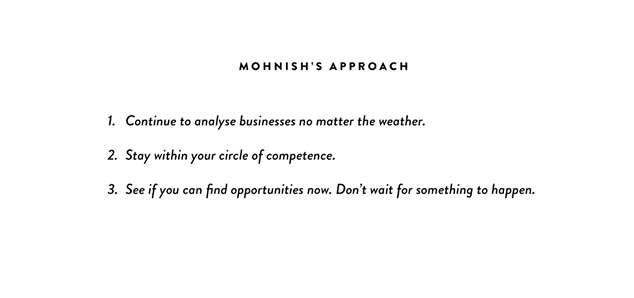
Don’t get stuck in your comfort waiting for the stock market to get better. Instead, focus on think through if the business is within your circle of competence. Then check if the stock is cheap or expensive. If it’s a high-quality business, though expensive, it may be worth betting on.
Pabrai added, “There are some businesses which may not get impacted much by credit. The nature of the business may not keep. For example, I look at a business like Jio. What impact is Covid going to have on Jio? I don’t think it makes much difference if people need to communicate. They have a bigger degree, need to communicate even when they can’t see each other. So, if anything, a business like Jio gets better. On the other hand, let’s say private hospitals. The government put all kinds of mandates on them, and it may or may not make money so becomes a lot murkier whether what would happen within the next year or two. The real question is on the clarity.”
The strike of the COVID-19 pandemic may seem to be a lot of trouble, it surely is, however it is some sort of a golden opportunity for some telecommunication and social media companies. Not every business is affected in the same magnitude in today’s trouble.
Don’t think too much about the disturbance of COVID-19 in the stocks. Instead, continue analyzing businesses individually despite the weather. Look if there’s a good opportunity within your competence, then grab it.
Why wait for the trouble to subside when you can take advantage of it if you do it wisely? There is always an opportunity somewhere.
Keep Your Head Cool
If you already have an investment for a company that is getting pushed to its edge, there’s no need for you to worry if the management team of the company is still investing well, having only minimal debt and an ample amount of cash to cover the companies’ knockdowns.
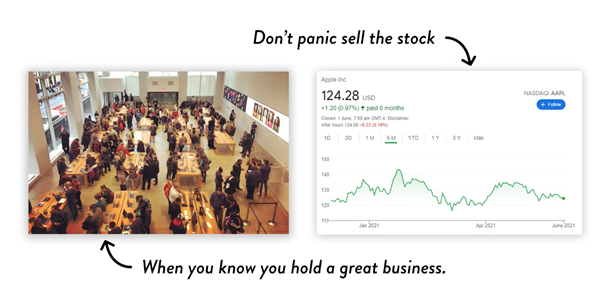
“If you say to me that the company has a great capital allocation, and their balance sheet can easily handle whatever hiccup a year or two or three is producing. At the core, it is a great business. I hate the hotel business. You go on make my trip or whatever and you transparently see all the prices, and then you pick the lowest price. That’s a useless business. Your dumbest competitor is setting a price. You can figure out that the core business is a great business run by great capital allocators,” Pabrai expressed.
What Pabrai wants to highlight is that you can keep your head cool and don’t let your emotions get ahead of you, especially when you know that you hold a great business.
Patience Pays Off
There’s a lot of great companies that are skyrocketing right now. However, several of them are pretty expensive.
To find the best ones among the good-performing companies out there, Pabrai gave us this message, “You only need one of those in your lifetime. You have 50 years as an investor, and you only need to be right once. For example, there’s a company in South Africa, which is now 106 years old. It’s like a book and magazine newspaper publishing company, the company called NASPERS. In 2001, NASPERS invested $32 million into a Chinese company called Tencent, and they got 43 stakes in that business. In 20 years they owned it, they never sold stock.”
NASPERS investment of $32 million grew about 8000%, amounting to $200 billion. Pabrai points up that NASPERS has faced massive pressure as Tencent grows, but they hold on, believing in the great potential of Tencent in the future time.
As investors, you don’t always have to be right. Instead, you need patience in finding the right opportunity. Once you do, bet on it all throughout.
The greatest lesson in Pabrai’s example is the importance of stretching out time horizons for investments. To put it simply, if the business is compounding really well, don’t just let it go, and hold on to it well.
As an investor, the best thing you can do is to look for long term-compounders. These are companies which you think will do well for several decades. Even if you overvalued a company and pay too much, if the company is a long-term compounder, it doesn’t really matter.
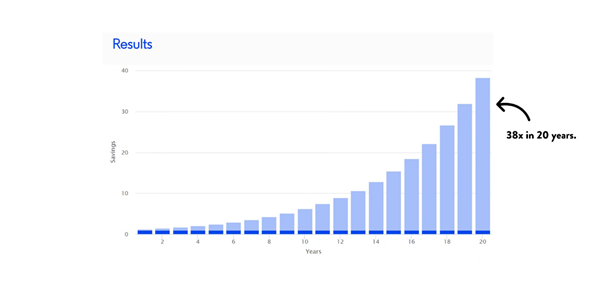
Let’s say you buy a stock worth $1 for $3. If the company is growing 20% every year, after 10 years, the company will be 10 times bigger, and 38 times bigger after 20 years. Hence, paying three times bigger than its true value is not bad at all if the company is compounding well.
Right now, every stock seems to be seemed to be too expensive, and so you need to focus on the long-term. Holding an incredible stock for a long period of time will have you good gains.
In 2010, Apple was only about $6 to $12 per share. Let’s say your friend bought stocks and you’ve decided to pass, thinking the price was too high. The company had gone up 100% in a year.
At this moment, your friend must’ve enjoyed the fruit of his investment somewhere out there or is already retired because of the gains he acquired. On the other hand, there’s you who is exhausted working your 9-5 job.
You don’t have to wait for the perfect time to buy stocks. Patience and the disposition to hold long-term compounders is the secret to today’s investing climate.

